
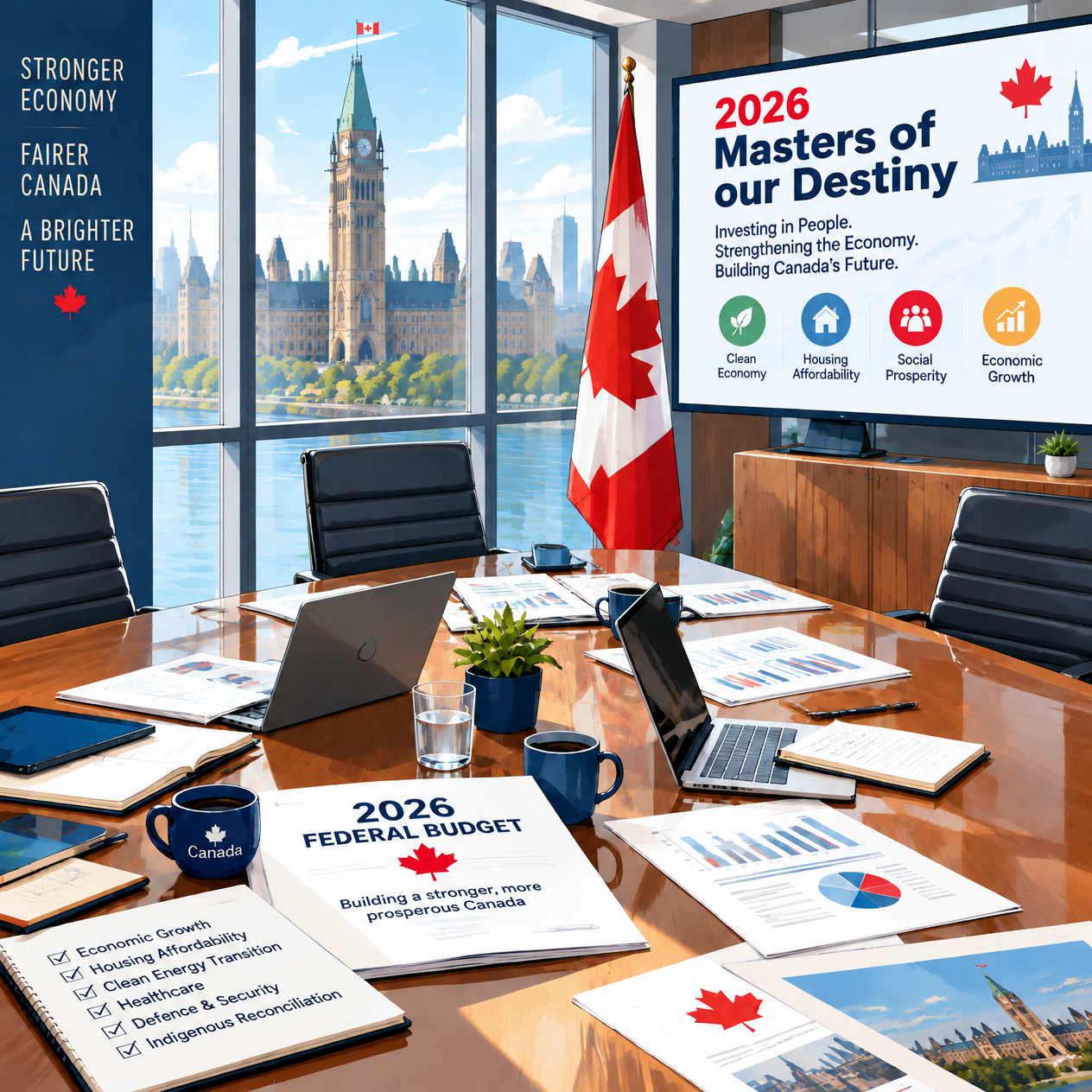
On November 5, 2026, the federal government released its 2026 Federal Budget, titled Masters of our Destiny. The budget includes several proposed changes that could affect Canadians, families, business owners, investors, retirees and employers.
While there are no proposed changes to personal or corporate income tax rates, the budget introduces a number of changes to tax credits, registered savings plans, business investment incentives and tax reporting requirements.
Some measures are intended to make the tax system simpler, while others aim to encourage investment, support Canadian businesses and provide additional financial support to individuals and families.
Here is a breakdown of the key announcements and what they could mean.
Personal income tax filing deadline moves to May 15
One of the more straightforward changes is a proposed extension to the personal income tax filing and payment deadline.
Currently, most Canadians must file their income tax returns and pay any outstanding balance by April 30. Self-employed individuals and their spouses or common-law partners have until June 15 to file, but any taxes owing must still be paid by April 30.
Under the proposed changes, everyone would have the same deadline:
This change would apply beginning with the 2027 tax year.
A new "RRSP for life"
The government is proposing to combine the main features of Registered Retirement Savings Plans (RRSPs) and Registered Retirement Income Funds (RRIFs) into one account, called an "RRSP for life."
Currently, Canadians must convert their RRSPs into a RRIF or another permitted option by the end of the year they turn 71. Once converted to a RRIF, minimum annual withdrawals are required.
The proposed changes would remove the need to convert an RRSP to a RRIF at age 71. Instead, the account could remain an RRSP, although minimum withdrawals would still be required after age 71.
The government is also considering two additional changes:
These changes are still being considered. The government is asking Canadians to provide feedback by January 8, 2027.
Registered Disability Savings Plans (RDSPs)
A Registered Disability Savings Plan helps individuals who qualify for the Disability Tax Credit save for their long-term financial needs.
Generally, an adult beneficiary manages their own RDSP. If they are unable to legally enter into a contract because of a mental impairment, a legal representative must usually manage the account.
A temporary rule currently allows certain family members to open and manage an RDSP when the beneficiary's ability to enter into a contract is in doubt and they do not have a legal representative.
Eligible family members include:
This temporary rule was scheduled to end in December 2026. The budget proposes to make it permanent, helping families continue to establish RDSPs for eligible individuals who need assistance.
Additional support for groceries and essentials
The Canada Groceries and Essentials Benefit (CGEB), formerly known as the GST Credit, is a non-taxable benefit for eligible lower-income individuals and families.
The budget proposes a one-time additional payment in early 2027, equal to half of the maximum annual benefit amounts for the 2026–27 benefit year.
The maximum additional payments would be:
The actual amount received will depend on household income and eligibility. The additional payment would be calculated using adjusted income phase-in and phase-out rates, so the supplement would follow the same income limits as the existing benefit.
Canada Caregiver Credit becomes refundable
The Canada Caregiver Credit provides tax relief to individuals who support certain family members or dependants with physical or mental impairments.
Currently, this is a non-refundable tax credit. This means it can reduce the amount of income tax someone owes, but it cannot create a refund if the individual has little or no tax payable.
The budget proposes to make the credit refundable beginning with the 2027 tax year.
This means eligible caregivers could receive the full credit even if they have little or no income tax to pay. The existing credit amounts, income limits and annual inflation adjustments would remain in place.
More time and flexibility for family farm transfers
The current tax rules allow certain farming and fishing property to be transferred to the next generation without immediately triggering capital gains tax.
These rules currently apply to qualifying transfers to children, grandchildren and great-grandchildren, including certain transfers involving their spouses or common-law partners.
The budget proposes to expand these rules to include transfers to:
This would allow more families to transfer qualifying farming and fishing property to the next generation while deferring capital gains tax.
The proposed change would apply to transfers made on or after January 1, 2027.
Higher threshold for reporting foreign investments
Canadians who own certain types of foreign property may be required to file Form T1135, also known as the Foreign Income Verification Statement.
Generally, this reporting requirement applies when the total cost of specified foreign property exceeds $100,000 at any point during the year.
Examples can include certain foreign investments and income-producing property held outside Canada. Personal-use property and property used in an active business are generally excluded.
The budget proposes two changes:
This means fewer Canadians may need to complete the more detailed reporting requirements.
The changes would apply to tax years ending after 2026.
Optional flat-rate tax deductions
The government is proposing several optional flat-rate amounts to make claiming certain deductions and credits easier.
Instead of tracking and submitting actual eligible expenses, individuals could choose to claim a set amount. Eligibility requirements would still apply.
The proposed amounts include:
Expense or deduction | Optional flat amount |
Eligible moving expenses | $1,000 |
Clergy residence deduction | $1,000 per eligible month, up to $12,000 annually |
Eligible tradesperson temporary relocation | $1,500 annually |
Home accessibility expenses | $1,000 one-time amount |
Adoption expenses | $1,200 per adopted child |
These changes would generally apply beginning with the 2027 tax year.
The goal is to reduce paperwork and make it easier for eligible individuals to claim deductions without having to calculate every expense.
Changes to medical and disability expense claims
The budget proposes to simplify the documentation needed to claim certain expenses under the Medical Expense Tax Credit and Disability Supports Deduction.
Currently, individuals generally need to keep receipts and may also need a prescription or written certification from an authorized medical professional.
Under the proposed changes:
The Canada Revenue Agency (CRA) would still have the authority to request additional information to confirm eligibility.
The changes would apply to the 2026 and subsequent tax years.
Additional flat-rate medical and disability expense amounts
The budget also proposes optional flat-rate amounts for certain expenses:
These amounts would provide an alternative to tracking actual eligible expenses. Individuals would still need to meet the applicable eligibility requirements.
More flexibility for commission employees
Commission employees who meet certain conditions can currently deduct employment expenses up to the amount of their commission income.
However, they generally cannot claim travel and motor vehicle expenses under the regular employee deduction rules if they also claim expenses under the commission employee rules.
The budget proposes to remove this restriction.
This would allow eligible commission employees to claim travel and vehicle expenses under the general employee rules while also claiming other eligible employment expenses under the commission employee rules, up to their commission income.
The change would apply beginning with the 2027 tax year.
Changes to scholarship, fellowship and bursary income
Currently, certain scholarships, fellowships and bursaries can qualify for a tax exemption. However, a student may not qualify if they receive financial assistance for their educational program from an employer or another unrelated party.
The budget proposes to remove this restriction.
This means receiving financial assistance from an employer or another unrelated organization would no longer automatically prevent a student from claiming the tax exemption on eligible scholarship, fellowship or bursary income.
The change would apply beginning with the 2027 tax year.
More deductions for employed artists
Employed artists can currently deduct certain expenses related to their artistic work. However, the deduction is generally limited to the lesser of $1,000 or 20% of their employment income from those activities, after certain other deductions.
The budget proposes to replace this limit with a deduction equal to the artist's employment income from eligible artistic activities.
This would provide more room to deduct eligible expenses.
The change would apply beginning with the 2027 tax year.
A proposed Canada Creative Credit
The government has announced plans to consult with Canadians and the cultural sector on a new Canada Creative Credit.
The proposed credit would support artists involved in original creative work, artistic production and cultural entrepreneurship.
It is expected to be a non-refundable personal income tax credit. When combined with the Basic Personal Amount, it would provide tax recognition on up to $45,000 of qualifying annual net business income from original and creative artistic works.
More details are expected in the Spring Economic Update 2027.
Changes to income tax instalments
Some individuals and corporations must pay income tax throughout the year through instalments rather than paying the full amount when they file their tax returns.
The budget proposes to increase the amount of tax owing before instalment payments become necessary.
For individuals living outside Quebec and corporations, the threshold would increase from $3,000 to $7,500.
For individuals living in Quebec, the federal threshold would increase from $1,800 to $4,500.
These thresholds would be adjusted for inflation and rounded to the nearest $500.
The changes would apply to tax years beginning on or after January 1, 2028.
One annual payment for individuals with business income
Individuals whose main source of income comes from a business, including professional and commission income, would also have the option to make one annual instalment payment instead of quarterly payments.
The annual payment would equal two-thirds of their combined federal and provincial net tax owing for the year and would be due by December 31. The remaining balance would be due on the regular tax payment deadline.
This change would apply beginning with the 2028 tax year.
Increased support for workers
The Canada Workers Benefit (CWB) is a refundable tax credit that helps eligible lower-income workers.
The budget proposes to increase the benefit and rename it the Build Canada Workers Benefit (BCWB).
For the 2027 tax year, the proposed changes include:
The disability supplement would also continue to be available to eligible individuals receiving the Disability Tax Credit. Its income phase-in threshold would decrease from $1,150 to $200.
The government is also proposing to change advance payments. The advance payment would be reduced from 50% to 25% of the previous year's benefit for 2027, then eliminated beginning in 2028.
Changes to government benefit payments
The budget proposes to change how smaller government benefit amounts are paid.
Currently, certain smaller benefit amounts are issued as one annual lump-sum payment rather than regular payments throughout the year.
The government proposes to increase the thresholds at which this happens:
These changes would apply to benefits paid after June 2027.
The government also proposes to adjust the income thresholds for the CCB and CGEB annually for inflation, rounded to the nearest $5, beginning in July 2028.
Additional deductions for tradespeople and northern residents
The budget includes two additional changes affecting certain workers.
Apprentice vehicle mechanics:
Northern residents:
Increased tax support for volunteer firefighters and search and rescue volunteers
Currently, volunteer firefighters and search and rescue volunteers can each claim a separate non-refundable tax credit.
The budget proposes to combine these into one credit worth 14% of $6,000.
Eligible volunteers who complete at least 200 hours of qualifying service during the year could claim the credit. Hours spent as either a volunteer firefighter or a search and rescue volunteer would count toward the same 200-hour requirement.
An individual could claim the combined credit, but not both of the existing separate credits.
This change would apply beginning with the 2027 tax year.
Extended mineral exploration tax credits
The Mineral Exploration Tax Credit and Critical Mineral Exploration Tax Credit are designed to encourage investment in mineral exploration through flow-through share investments.
The budget proposes to extend eligibility for both credits by five years, allowing qualifying agreements entered into on or before March 31, 2032.
The Critical Mineral Exploration Tax Credit would also be expanded to include antimony as an eligible critical mineral.
The antimony change would apply to qualifying expenses under eligible agreements entered into after Budget Day and on or before March 31, 2032.
More time to object to tax assessments
The budget proposes to change the deadlines for taxpayers who want to formally object to an income tax assessment.
For most taxpayers, the deadline would increase from 90 days to one year after the notice of assessment is sent.
For individuals and graduated rate estates, the deadline would become the later of:
The current option to apply for an extension after missing the objection deadline would be removed.
These changes would apply to assessments issued on or after the date that is three months after the legislation receives Royal Assent.
A new $15-million capital gains exemption for business owners
One of the largest announcements in the budget is the proposed Canada Growth Incentive (CGI), which would introduce a new capital gains exemption of up to $15 million for qualifying business share sales.
The exemption would allow eligible Canadian-resident individuals to sell qualifying shares of a qualifying corporation and receive an exemption on up to $15 million in capital gains for each qualifying business.
This is a significant proposed change for business owners considering a future sale or succession plan.
However, there are several eligibility requirements.
Individual requirements:
Business requirements:
Which businesses would not qualify?
Certain industries and business structures would be excluded, including:
The exemption would also be subject to additional rules designed to prevent business owners from multiplying the exemption by using several corporations to operate the same underlying business.
How does this work with the existing Lifetime Capital Gains Exemption?
The new exemption would interact with the existing Lifetime Capital Gains Exemption (LCGE).
An individual could not claim both exemptions on qualifying share sales of the same corporation without affecting the available exemption under the other program.
However, the budget proposes that qualifying individuals could generally use both the CGI exemption and the separate exemptions available for sales to Employee Ownership Trusts or worker cooperatives.
Capital gains exempted under the new program would also be subject to a 30% inclusion rate for Alternative Minimum Tax purposes.
The proposed measure would apply to qualifying shares issued after Budget Day and before 2037.
More time to reinvest proceeds from small business share sales
Currently, individuals who sell qualifying eligible small business corporation shares can defer capital gains tax if they reinvest the proceeds into replacement eligible small business shares during the year of sale or the following calendar year.
The budget proposes to extend this reinvestment period.
Under the proposed rules:
The government is also proposing to lower the asset-use requirement during the shareholding period from "all or substantially all" to "primarily." However, the higher requirement would still apply when shares are issued and when they are sold.
The business must also continue to meet the applicable Canadian active-business requirements.
If the required replacement shares are not issued by the end of the extended period, the deferred capital gain would become taxable. Interest may also apply to proceeds that are not ultimately reinvested.
These changes would apply to qualifying share sales on or after January 1, 2027.
Increased support for research and development
The Scientific Research and Experimental Development (SR&ED) program provides tax incentives to businesses conducting eligible research and development in Canada.
The budget proposes to expand the types of activities and expenses that can qualify.
Two important changes are being proposed:
These changes would make it easier for businesses to recognize additional costs associated with developing and bringing new products and processes to market.
The changes would apply to taxation years beginning on or after Budget Day.
Extended clean technology investment tax credits
The government proposes to extend the Clean Electricity and Clean Technology investment tax credits.
Eligible property would continue to qualify if it becomes available for use before 2041, extending the program beyond its previously planned end date.
The Clean Technology investment tax credit would still decrease to 15% in its final year, but that final year would move from 2034 to 2040.
This provides businesses with a longer period to plan and invest in qualifying clean technology and electricity projects.
Changes to corporate tax instalments
Corporations generally must make monthly or quarterly income tax instalments unless their total federal income tax payable is $3,000 or less for the current or previous tax year.
The budget proposes to increase this threshold to $7,500.
This means more businesses could avoid making regular tax instalment payments throughout the year.
The new threshold would be indexed to inflation and rounded to the nearest $500.
The change would apply to taxation years beginning on or after January 1, 2028.
More flexibility when transferring losses between related corporations
Currently, corporations are generally taxed separately. This means one corporation cannot directly use another corporation's losses to reduce its own taxable income, even when both companies belong to the same corporate group.
Businesses sometimes use reorganizations, amalgamations or other transactions to move losses within a corporate group. However, these arrangements can be complicated, expensive or impractical.
The government is consulting on a new system that could allow certain related corporations to transfer current-year non-capital losses between them.
The proposed rules would allow transfers between:
Both corporations would need to make a joint election. The receiving corporation could then deduct the elected amount, while the transferring corporation would reduce its available loss by the same amount.
The proposal would generally apply to Canadian-resident corporations that pay tax under Part I of the Income Tax Act. Certain corporations that act as a pass-through for their shareholders or members would be excluded.
There would also be rules to prevent losses from being moved between provinces or territories in a way that reduces the wrong jurisdiction's tax revenue. A loss arising in one province or territory could only be transferred to offset income arising in that same jurisdiction.
This measure is still under consultation, and an effective date has not been announced. The government is accepting written submissions until January 8, 2027.
Changes to corporate tax elections
Some corporate tax elections and agreements currently require a certified copy of a directors' resolution or other authorization to be filed with the CRA.
The budget proposes to remove this requirement for certain elections and agreements.
This would reduce administrative paperwork for businesses.
The change would apply to elections and agreements made on or after the legislation receives Royal Assent.
Changes to preferred share taxation
Preferred shares are a type of company share that can provide investors with dividend payments and certain features similar to debt financing.
Currently, certain dividends paid on taxable preferred shares are subject to a special corporate tax known as Part VI.1 tax.
The budget proposes two changes:
The second change would apply to taxation years ending after 2026.
The government is also reviewing the broader preferred share tax rules and is seeking feedback on potential improvements.
Changes to Individual Pension Plans
An Individual Pension Plan (IPP) is a type of defined benefit pension plan generally designed for a small number of members, often business owners and related employees.
The budget proposes to expand the definition of an IPP to include certain defined benefit pension plans where all members are related to the participating employer or are not dealing at arm's length with a member who is related to the employer.
This change would apply beginning January 1, 2027.
The budget also proposes additional rules beginning January 1, 2028.
These would include:
An IPP exceeding this 200% limit would become a "revocable plan." The CRA would need to provide at least 30 days' notice before issuing a revocation letter, giving the plan an opportunity to correct the issue.
If an RPP registration is revoked, additional tax consequences would apply. These include a special tax equal to 10% of the plan's assets immediately before revocation, subject to possible CRA relief. The plan would also be treated as a Retirement Compensation Arrangement, with a 50% refundable tax applying to the deemed contribution of its remaining assets after the revocation tax.
Transitional rules would apply to certain investments acquired before 2028.
Administrative penalties for businesses
The budget proposes changes to certain administrative penalties under federal tax legislation.
These additional penalties would generally apply when:
These changes would apply to taxation years and fiscal periods ending after 2027.
Some budget announcements affect both individuals and businesses or involve broader financial and tax administration changes.
Changes to tax treatment of certain trust distributions
Currently, certain trusts can transfer property to Canadian-resident beneficiaries without immediately triggering capital gains tax.
This tax-deferred treatment generally does not apply when property is transferred to a non-resident beneficiary, subject to limited exceptions.
The budget proposes to expand these restrictions to include indirect transfers.
For example, a trust could lose access to the tax-deferred rollover when transferring property to a corporation or partnership that has a direct or indirect non-resident shareholder or partner.
This change would apply to property distributions made on or after Budget Day.
Changes when non-residents sell Canadian property
When a non-resident sells certain Canadian property, the purchaser may be required to withhold and send a portion of the purchase price to the CRA to cover the seller's potential Canadian tax liability.
This can apply to Canadian real estate, resource properties and certain shares or interests whose value comes mainly from Canadian real estate or resource assets.
Currently, the general withholding rates are:
The budget proposes to reduce these rates to:
The budget also proposes to remove the withholding and payment requirements for fully tax-deferred Section 85 rollovers, provided certain conditions are met.
For this exemption, the Section 85 election must be filed within 30 days of the transaction, and the purchaser must provide the CRA with the required transaction and seller information.
An existing anti-avoidance rule for certain transactions would also be strengthened.
These changes would apply to transactions occurring on or after January 1, 2027.
CRA disclosure of tax debt to credit bureaus
The government proposes to give the CRA the authority to report certain outstanding tax debts to credit bureaus.
This could affect an individual's or business's credit information, but only when specific conditions are met.
The proposed rules include:
Similar rules would apply to outstanding GST/HST debts.
This measure would take effect when the legislation receives Royal Assent.
New CRA income verification service for mortgage applications
The budget proposes to allow the CRA to enter into agreements with mortgage lenders and mortgage insurers to provide an income verification service.
The goal is to make mortgage applications more reliable and efficient while helping prevent mortgage fraud.
The proposal would give lenders and insurers a way to verify income information through the CRA.
Higher Canada Deposit Insurance Corporation coverage
The budget proposes to modernize Canada's deposit insurance system through changes to the Canada Deposit Insurance Corporation (CDIC) framework.
The proposed changes include:
These changes are intended to provide greater protection for Canadians' deposits. The budget does not provide all the implementation details in the material reviewed.
GST/HST changes for health services and medical devices
The budget proposes several changes to GST/HST rules for health-related services and products.
Changes to Indigenous tax arrangements
The budget proposes two changes to tax arrangements with participating First Nations governments.
The 2026 Federal Budget includes a mix of proposed tax changes, new incentives and consultations. Some measures have specific implementation dates, while others still require additional consultation or legislation before they become law.
It is important to remember that budget announcements are not automatically law. Proposed measures must go through the legislative process and receive Royal Assent before they become official.
As more details become available and legislation is introduced, the final rules and implementation dates may change.
This article is intended for general educational purposes and summarizes selected announcements in the November 5, 2026 Federal Budget. It is not tax, legal, accounting or financial advice. Individual and business circumstances differ, and proposed measures may change before becoming law.
Sources:
Mackenzie Tax and Estate Planning Team – 2026 Federal Budget Analysis.
Canada Life – 2026 Federal Budget Analysis: Tax Highlights.
As financial planners, we do not provide specific tax and legal advice. You should always consult your accountant and/or lawyer where necessary. Because of the many ways a strategy may be impacted when segmented, we prefer to communicate collectively with your external professionals to ensure that all recommendations and action plans are in the overall best interest of you, with your professionals working with common goals in mind.
You are never obligated to act on our recommendations of products, services, or advice.